


The modern football landscape demands more than passion and tradition—it requires strategic innovation. The Football AI Audit represents a comprehensive diagnostic and strategy process designed specifically for football clubs seeking to understand where and how artificial intelligence can deliver measurable improvements in performance, revenue, and operational efficiency.
Understanding the Unique Context of Football Operations
Football clubs operate in a fundamentally different environment compared to traditional businesses. They function as community institutions with commercial imperatives, balancing multiple competing priorities simultaneously. From match-day operations and player development to fan engagement, sponsorship obligations, regulatory compliance, and grassroots outreach, clubs manage extraordinary complexity—often with limited resources and lean operational teams.
Generic AI consultants typically fail to grasp these nuances. They propose standardized solutions like chatbots and dashboards without understanding the specific challenges football organizations face: managing ticket pricing during unpredictable cup runs, tracking youth player progression across multiple age groups, or personalizing communication for thousands of season ticket holders without massive marketing budgets.
The Football AI Audit addresses these real-world scenarios directly. Rather than chasing technology trends or installing random software, it systematically audits your current systems, data infrastructure, and workflows, then demonstrates exactly where artificial intelligence in football creates measurable ROI.
Target Audience: Who Benefits from the Football AI Audit
This comprehensive process serves multiple stakeholders across the football ecosystem, each with distinct needs and challenges.
Club owners and directors require informed investment decisions and must demonstrate business modernization to boards and investors. They navigate the delicate balance between honoring tradition and embracing innovation, needing clarity on where AI delivers genuine value versus empty promises.
Operations heads and administrators find themselves drowning in spreadsheets, manual processes, and coordination challenges. These professionals manage season planning, compliance documentation, facility bookings, and the endless administrative burden that keeps clubs functioning day-to-day.
Commercial and marketing teams face the pressure of growing revenue, improving fan engagement, and proving sponsorship value in an oversaturated market. They need tools enabling personalization at scale while demonstrating concrete returns on marketing investments.
Academy directors and coaching staff bear responsibility for player development, talent identification, and creating pathways from grassroots to first team. They manage complex data about player progression, training loads, and potential—frequently across multiple systems that don’t integrate effectively.
League and association management oversees multiple clubs, standardizes operations, and modernizes competition infrastructure. They seek scalable solutions benefiting the entire football pyramid, not exclusively organizations with substantial financial resources.
Core Objectives: Measurable Outcomes That Matter
1. Identifying Opportunities for Time Savings, Cost Reduction, and Revenue Growth
Every club harbors inefficiencies—hours consumed by tasks suitable for automation, revenue opportunities missed due to poor data visibility, or resources wasted on processes that don’t scale effectively. The audit maps these gaps systematically, revealing exactly where AI creates genuine business value.
This might involve automating match-day staff scheduling, implementing predictive analytics for dynamic ticket pricing, or using AI football analytics to identify sponsorship inventory currently being undersold. The emphasis remains consistently on measurable impact rather than theoretical possibilities.
2. Developing a Practical Implementation Roadmap
Technology without strategy becomes expensive noise. The audit delivers a clear, phased implementation plan respecting your budget constraints, organizational capacity, and operational reality. No jargon. No overwhelming technical specifications. Just practical next steps your team can actually execute.
This roadmap prioritizes quick wins that build momentum and demonstrate value early, creating internal buy-in for more ambitious initiatives subsequently. It considers existing systems, staff technical literacy, and change management capacity—because even the best AI solution means nothing if your team cannot or will not use it effectively.
3. Providing Decision-Maker Clarity Before Major Commitments
Perhaps most importantly, the audit helps separate signal from noise in the chaotic world of AI in sports. What’s genuinely useful? What’s overhyped? What’s worth investing in immediately versus monitoring from the sidelines?
You’ll understand not just what AI can do, but what it should do given your specific circumstances. This clarity protects against costly mistakes and provides confidence in your modernization strategy.
The Football AI Audit Methodology: A Structured Approach
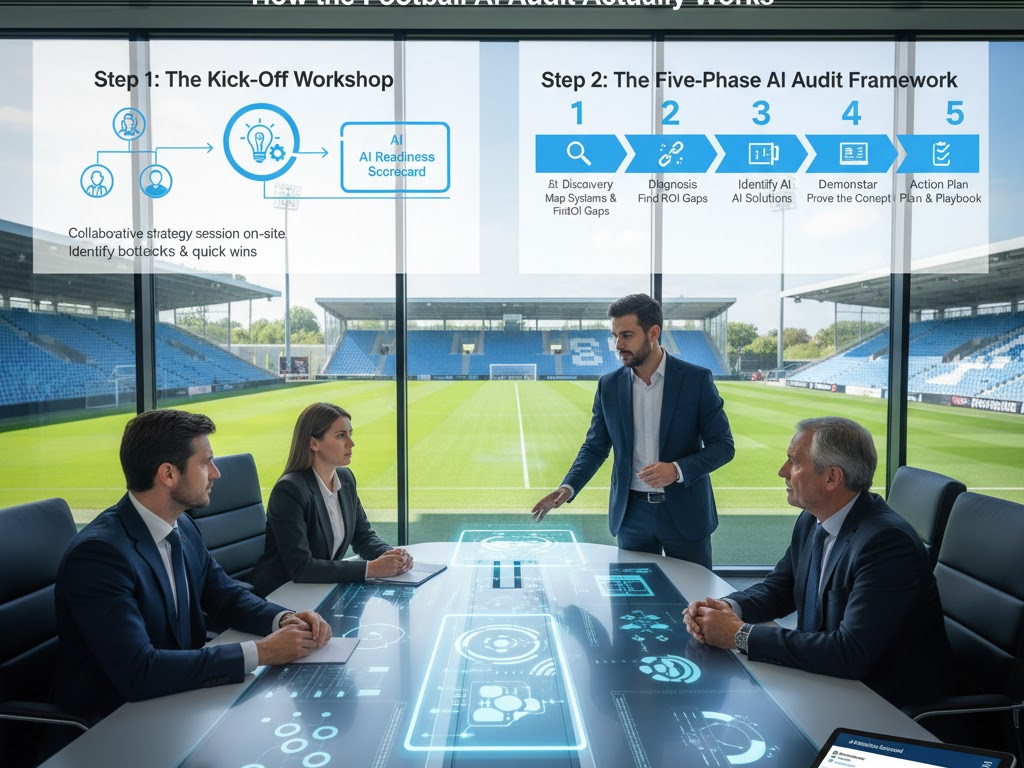
The process combines strategic thinking with hands-on exploration, ensuring recommendations are grounded in your club’s reality rather than generic best practices. This Audit to Action (A2A) begins with Step 1: The Kick-Off Workshop. The process starts with a half-day interactive session, ideally conducted on-site at your club, where leaders and key staff identify the areas of greatest struggle. This isn’t a lecture—it’s a collaborative strategy session focused on your specific challenges.
Whether addressing administrative burden, fan engagement, sponsorship activation, data management, or player operations, the workshop explores the real bottlenecks limiting your potential. The session is deliberately non-technical, designed to unlock quick wins and build shared understanding across departments. Participants aren’t expected to understand machine learning or algorithms. They’re expected to know their roles and articulate their frustrations. That’s the essential raw material required.
The output includes shared understanding of your club’s “AI readiness” and consensus on top-priority areas for automation or insight. Everyone leaves aligned on what matters most and why. Each workshop participant receives a custom “AI Readiness Scorecard”—a personalized assessment showing where AI can make the fastest impact in their specific role.
Step 2: The Five-Phase AI Audit Framework
Following the workshop, a structured audit unfolds through five distinct phases, forming the core of the Audit to Action (A2A) approach.
Phase 1: Discovery – Understanding Your Current State
This phase maps how your club actually operates today. How is data currently collected, stored, and used? What systems are running? Where do workflows break down? Who has access to what information? This produces a comprehensive club map of systems and workflows—often revealing surprising disconnects between departments or redundant processes draining resources.
Phase 2: Diagnosis – Finding the Gaps
With a clear picture of current state, the audit identifies specific inefficiencies or missed opportunities. Where is human time wasted on repetitive tasks? Where are fans dropping off in their journey? Where is valuable data sitting unused? The focus centers on ROI gap areas—places where small changes could unlock disproportionate value. This might include manual reporting consuming hours weekly, ticketing processes losing revenue during peak demand, or sponsorship tracking failing to prove value to partners.
Phase 3: Design – Identifying AI Solutions
This phase matches your specific challenges to appropriate AI tools and approaches. What could you automate? What could you predict? What patterns in your data could inform better decisions? This produces a custom AI roadmap tailored to your club, prioritized by impact and feasibility. The approach avoids one-size-fits-all solutions, instead identifying fit-for-purpose tools solving your actual problems.
Phase 4: Demonstrate – Proving the Concept
Strategy documents are easily ignored. Working prototypes are impossible to dismiss. This phase shows quick-win tools in action—perhaps a chatbot prototype for common fan inquiries, a ticket pricing model based on your historical data, or an automated reporting dashboard that currently requires hours of manual staff work. These demonstrations build internal buy-in and help stakeholders visualize the transformation, moving AI from abstract concept to concrete business tool.
Phase 5: Deliver – Your Action Plan
The audit delivers detailed recommendations and a clear action plan—your “Next 90-Day AI Playbook.” This includes specific tools, implementation sequences, resource requirements, success metrics, and risk mitigation strategies. You receive everything needed to execute independently or with external support, depending on your preference and capacity.
Technology Solutions: Tools Powering AI in Football
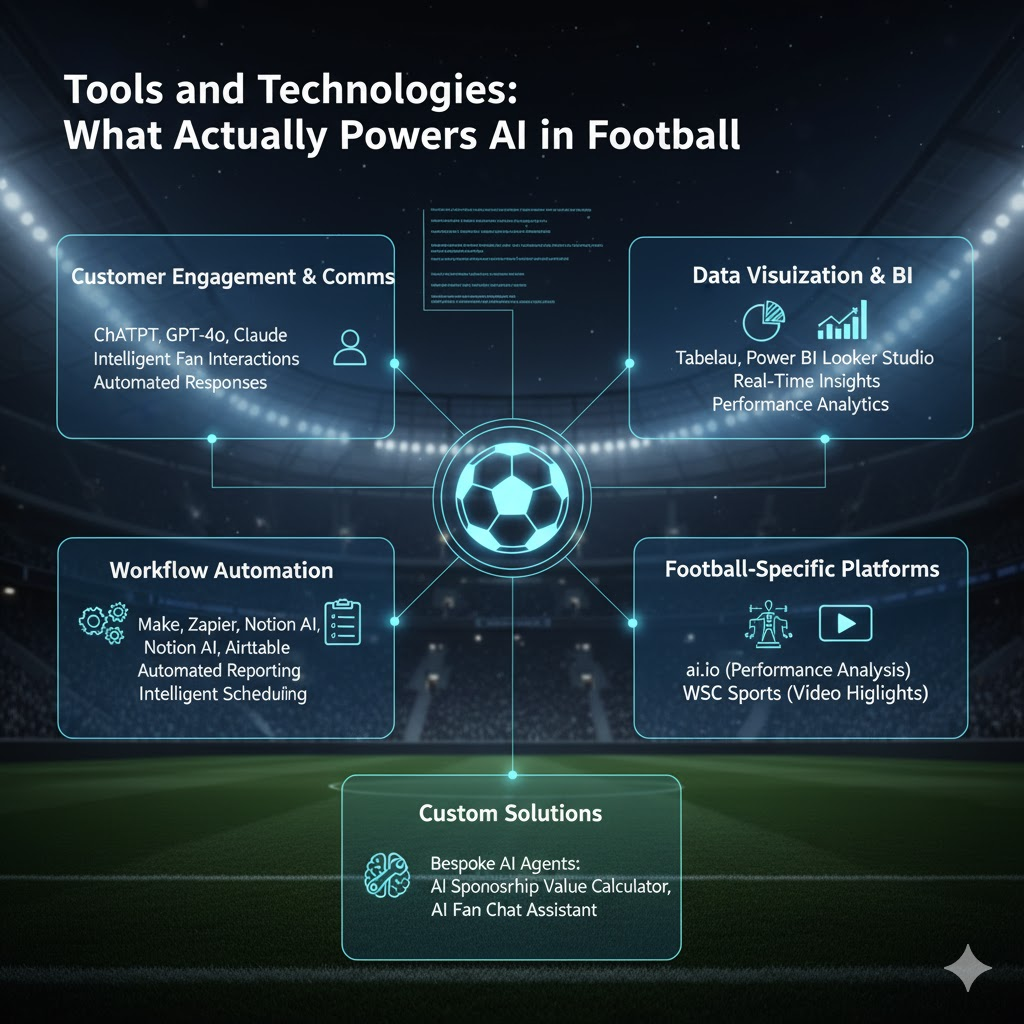
The Football AI Audit doesn’t sell proprietary platforms or push specific vendors. Instead, it identifies fit-for-purpose tools based on your needs and budget.
For customer engagement and communication, solutions like ChatGPT, GPT-4o, or Claude can power intelligent fan interactions, automate responses to common inquiries, and summarize complex data for decision-makers. These tools handle natural language beautifully, making them ideal for supporter services and internal knowledge management.
For workflow automation, platforms like Make, Zapier, Notion AI, and Airtable can eliminate repetitive administrative tasks. Imagine automated match-day reporting, seamless data flow between ticketing and CRM systems, or intelligent scheduling adapting to changing circumstances.
For data visualization and business intelligence, tools like Tableau, Power BI, and Looker Studio transform raw data into actionable insights. Suddenly your commercial team can see sponsorship performance in real-time, or your academy director can track player development trends across multiple cohorts.
For football-specific applications, specialized platforms provide performance analysis powered by AI in football business principles, while other solutions use AI to automatically create video highlights and content.
For custom solutions, bespoke AI agents can be developed—perhaps an “AI Sponsorship Value Calculator” that helps price inventory accurately, or an “AI Fan Chat Assistant” that handles common inquiries while routing complex questions to staff.
The key is matching technology to purpose. A grassroots club doesn’t need the same infrastructure as a Premier League team, and design occurs accordingly.
Real-World Applications: Concrete Value Creation
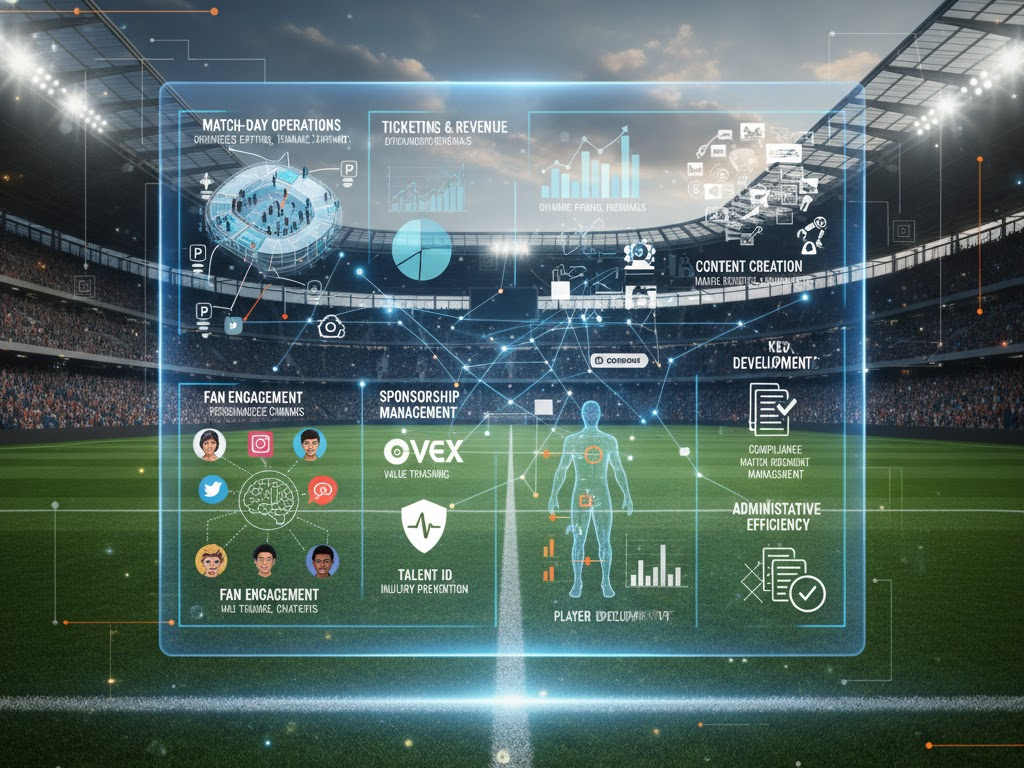
Match-Day Operations: AI can optimize staffing levels based on predicted attendance, weather, and historical patterns. It can manage parking allocation dynamically, predict concession demand to minimize waste, and coordinate security deployment efficiently.
Ticketing and Revenue: Dynamic pricing algorithms adjust ticket prices in real-time based on demand, maximizing revenue while maintaining accessibility. Predictive models identify likely renewals, enabling targeted retention campaigns.
Fan Engagement: Personalized communication at scale becomes possible when AI segments supporters based on behavior, preferences, and value. Chatbots handle routine inquiries instantly, freeing staff for complex supporter needs.
Sponsorship Management: AI tracks sponsorship inventory usage, proves value through detailed analytics, and identifies underutilized assets. It can match potential sponsors to relevant fan segments and predict partnership performance.
Player Development: In academies, AI helps track individual progression against benchmarks, identify at-risk players needing additional support, and spot talent that might otherwise be overlooked.
Content Creation: AI assists in generating match reports, social media posts, and marketing materials faster, allowing small teams to maintain professional output.
Administrative Efficiency: From automated compliance reporting to intelligent document management, AI eliminates countless hours of manual work that doesn’t directly serve your mission.
Investment and Return: What to Expect
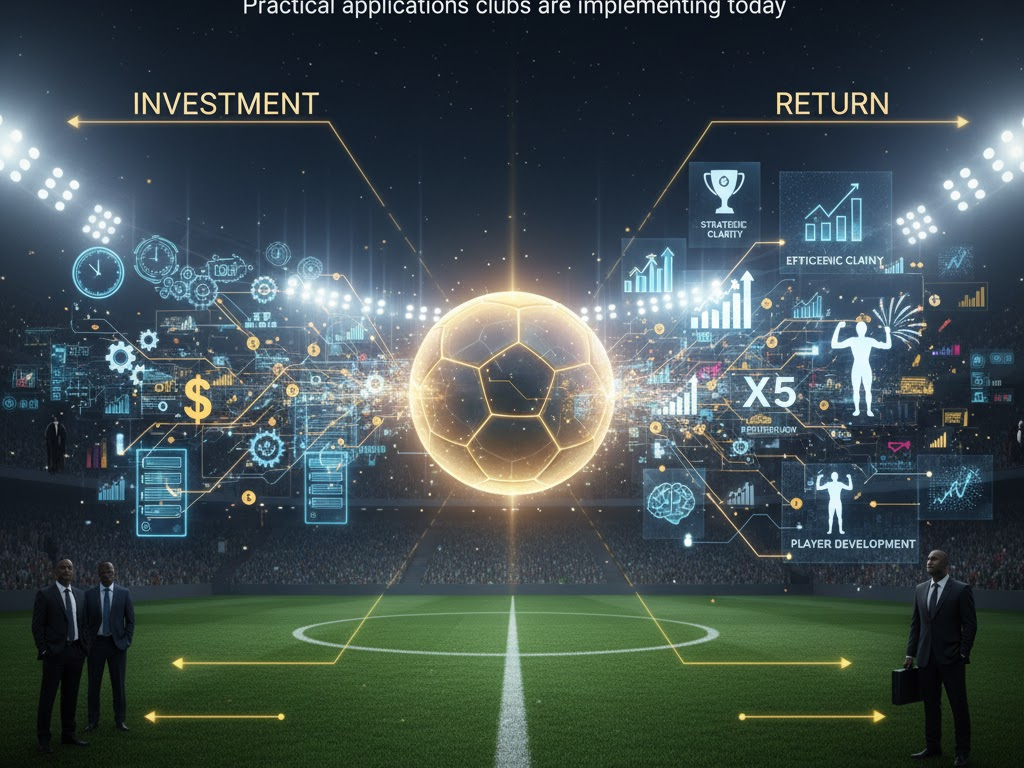
The Kick-Off Workshop requires a half day from key stakeholders. The full audit process typically spans 2-4 weeks depending on club size and complexity, with periodic check-ins rather than constant involvement.
Clubs typically identify efficiency gains and revenue opportunities worth 5-10x the audit investment within the first year. More importantly, you gain strategic clarity worth far more than immediate financial returns.
The Football AI Audit gives you clarity, confidence, and a concrete plan for transformation, meeting you where you are regardless of your current position in the football ecosystem.
Ready to transform your club? Book your Football AI Audit today and discover where AI can make the biggest difference in your operations, revenue, and impact.
Ready to Take Your AI Strategy Beyond the Basics?
If you’ve ever questioned whether The Big 4’s AI Audits: Brilliant Branding or Hollow Buzz?, now is the perfect moment to explore a more transparent and results-driven approach. Instead of settling for high-level presentations and recycled frameworks, you can experience a process designed to produce genuine clarity, measurable ROI, and actionable next steps.
By choosing a methodology shaped by Beyond the Big 4: How AI Audit Experts Is Redefining AI Assurance, your organization gains access to deeper analysis, industry-specific insight, and tailored recommendations that speak directly to your operational realities. This isn’t about buzzwords—it’s about uncovering real opportunities for efficiency, revenue growth, automation, and strategic modernization.
Whether you’re looking to streamline workflows, strengthen decision-making, enhance customer engagement, or future-proof your entire operation, this is your chance to move forward with confidence.
Book your AI Audit today and transform uncertainty into a clear, data-backed roadmap for the next stage of your organization’s growth.