
Auditing As AI systems scale, manual spreadsheets become obsolete. You cannot audit a Large Language Model (LLM) with billions of parameters using a clipboard and a pen. To keep pace with the velocity of modern software development, governance must be automated. This requires a shift toward sophisticated software solutions: the ai auditing tool, the ai assessment tool, and the assessment generator.
These technologies enable “Compliance as Code.” They integrate risk management directly into the technical workflow, ensuring that safety is not an afterthought but a continuous process. This article explores the landscape of these tools and how to select the right stack for your enterprise.
The Core Engine: The AI Auditing Tool
An ai auditing tool is a software application designed to inspect the behaviour of machine learning models. Unlike standard software debuggers, these tools focus on probabilistic outcomes. They ask: “Is this model fair?” and “Is this model robust?”
When selecting an ai auditing tool, look for these core capabilities:
- Bias Detection: The tool should automatically slice data by protected attributes (race, gender, age) and calculate metrics like “Disparate Impact” or “Equal Opportunity.”
- Explainability (XAI): The tool should provide feature importance charts (like SHAP or LIME values) to explain why the AI made a specific prediction.
- Drift Monitoring: The ai auditing tool must connect to your production stream and alert you if the live data starts looking different from the training data.
Leading open-source examples include IBM’s AI Fairness 360 or Google’s What-If Tool, but many enterprise ai auditing tool platforms now offer more comprehensive dashboards for non-technical stakeholders.
The Governance Layer: The AI Assessment Tool
While the auditing tool looks at the code, the ai assessment tool looks at the process. This is a broader platform that manages the workflow of compliance. It acts as the “Command Center” for risk.
An effective ai assessment tool tracks the lifecycle of every model in the organisation. It records who approved the training data, who signed off on the model weights, and when the last security review was conducted. Crucially, the ai assessment tool serves as the repository for evidence. It stores the logs, the charts, and the signed approvals. If a regulator conducts an investigation, this tool provides the “Audit Trail” necessary to prove due diligence.
Accelerating Documentation: The Assessment Generator
The most tedious part of compliance is writing reports. This is where the assessment generator creates massive ROI (Return on Investment). An assessment generator is a dynamic software feature that pulls data from your ai auditing tool and your ai assessment tool to automatically compile final reports.
Instead of a human auditor spending 20 hours copy-pasting graphs into a Word document, the assessment generator automatically populates the templates. It grabs the accuracy metrics from the testing phase, the bias charts from the auditing phase, and the stakeholder names from the intake phase, stitching them together into a coherent document. This ensures consistency. Every report produced by the assessment generator follows the exact same structure, reducing the risk of human error or omission.
Integration: The MLOps Pipeline
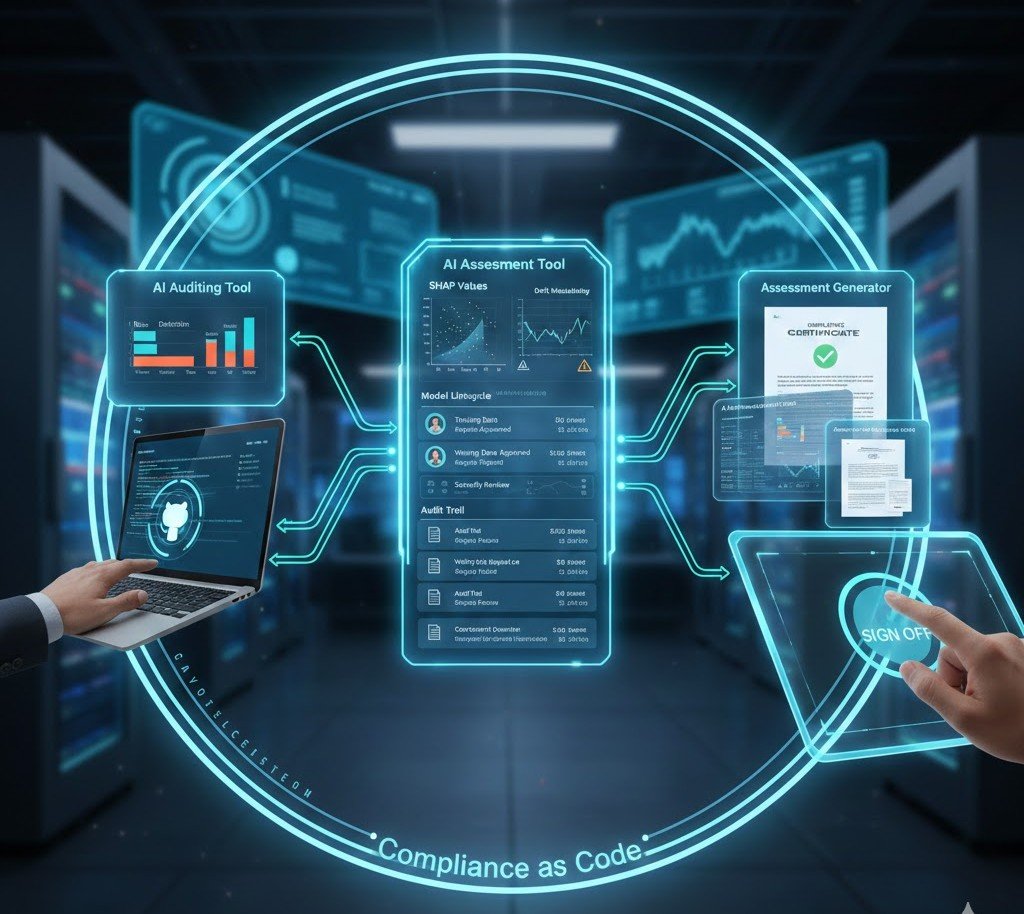
The holy grail of automation is full integration. In a mature setup, the ai assessment tool is triggered automatically by the CI/CD (Continuous Integration/Continuous Deployment) pipeline.
- A developer pushes code to GitHub.
- The ai auditing tool runs a battery of tests.
- If the tests pass, the assessment generator creates a draft compliance certificate.
- The system alerts the Human-in-the-Loop to review and sign off.
Conclusion: Tooling is Strategy
Investing in the right ai auditing tool and assessment generator is not just an IT decision; it is a strategic one. It frees up your high-value human talent to focus on complex ethical reasoning rather than data entry. By automating the routine aspects of compliance, you ensure that your organisation can innovate at speed without compromising on safety or legality.